
Narva understands the Kremlin playbook
Dr Amara Graps, a researcher in Baltic history and former reporter for The Baltic Independent, examines how Narva has withstood a destructive 20th century and continued attempts to divide it.
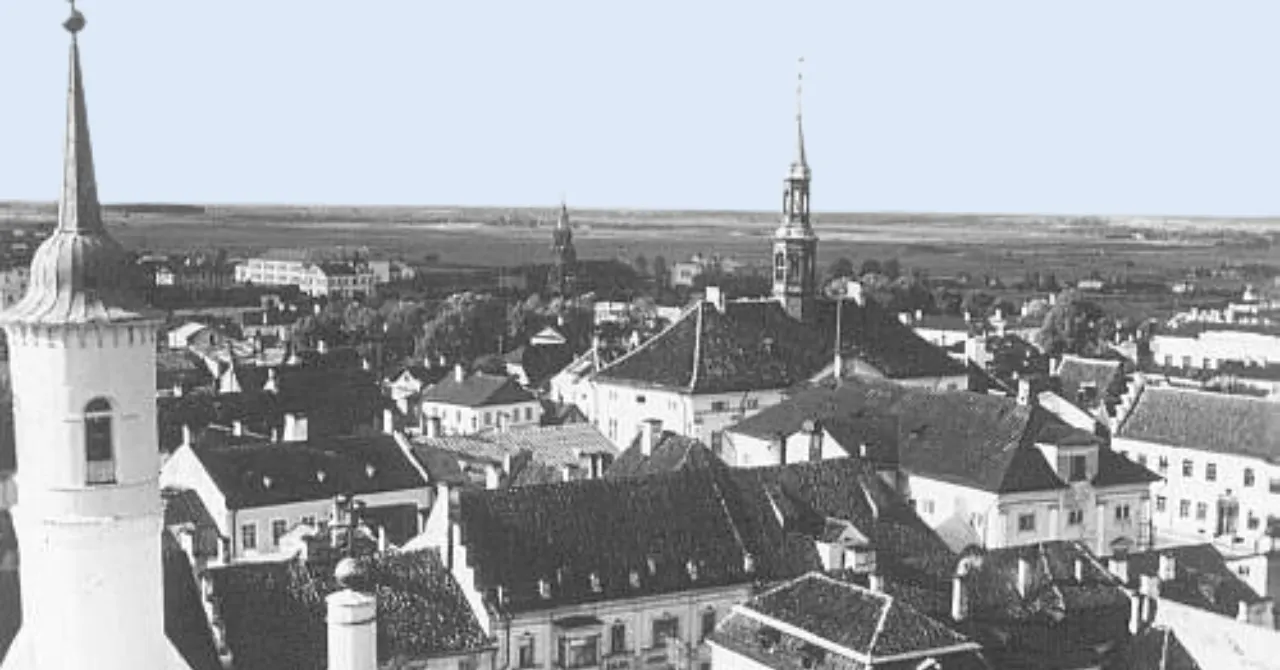
Before the Nazi-Soviet Pact helped tear apart the world around it, Narva was flourishing.
During the interwar period of Estonian independence, it was one of Estonia’s great industrial cities, dominated economically by the enormous Kreenholm textile complex, while its historic centre was among the architectural treasures of the Baltic region. Old Narva was a remarkably intact 17th-century Baroque city of merchant houses, churches, cobbled streets and grand civic buildings, sitting beneath Hermann Castle on the banks of the Narva River. Downstream, Narva-Jõesuu had developed into one of Estonia’s most fashionable seaside resorts.
Roughly two-thirds of its population was Estonian, living alongside Russians and other minorities in a genuinely multicultural border city. Narva had survived empires, wars and changing borders while retaining centuries of architectural and social continuity. Within little more than a decade, that continuity was shattered: occupations, war and Soviet rule devastated the old city, dispersed its pre-war population and ultimately replaced much of what remained with an almost entirely different urban landscape.

1944: ‘Liberation’ from its own pact
That changed the moment Stalin and Hitler carved up Eastern Europe between themselves in the August 1939 Molotov-Ribbentrop Pact, whose secret protocol filed the Baltic states under Moscow's "sphere of influence."
Weeks later, the Kremlin forced a so-called Mutual Assistance Pact on each of the three Baltic countries. Soviet troops stationed on the Baltics' own military bases then broke those pacts after only two months, with those same troops finishing the job with a full occupation in 1940. The 1944 Soviet "liberation" wasn't the opening act. It was already a rerun, destroying 95% of the old city in the process, then repurposing their own war-damage photo book to transfer responsibility entirely to their former Nazi-Soviet Pact partners.
Then the Kremlin paved over what was left of the city’s civilian memory with prefab housing, bulldozing over the ruins of destroyed lives and swapping unique Baroque architecture for identical concrete blocks.
1992: Occupiers outstaying their welcome
Fast forward five decades. Estonia formally anulled the Nazi-Soviet Pact, restored its independent state, and merely asked people who arrived during the occupation to apply for citizenship and be a full part of a great independent nation in which they have settled.
By June 1992, Estonia had its new constitution and 92% approval at the ballot box (turnout was 67%). Helpfully, Russia keeps its Red Army parked on Estonian soil. Respect for sovereignty, it turns out, comes with an army still parked on your soil, attempting to hold out as long as possible as leverage over your own citizenship laws.
This wasn't improvised. The "Yeltsin Doctrine," Russia's self-granted right to "protect" its minorities abroad, had already emerged the year before, right after the failed August 1991 Moscow putsch, and the Kremlin was already running it against Moldova. The Baltic Independent was calling the pattern out by name in its own June 1992 op-ed, calling it "a doctrine first promulgated in Germany between the wars." The same "right to intervene" logic the Nazis once used for the Sudetenland, now recycled for Russians in Moldova and Georgia, with Estonia and Latvia clearly next on the list.
The Kremlin, for its part, kept insisting troop withdrawal hinged on “human rights,” while running the Trans-Dniestr playbook a few borders over as a preview of coming attractions. Soviet OMON officers who’d fled Latvia after the failed August 1991 Moscow putsch resurfaced in Trans-Dniestr within months, recruited straight into the breakaway “Pridnestrovian Moldavian Republic’s” new National Guard. Same units, same tactics, different border.
Baltijet “Business Trips” to Moldova
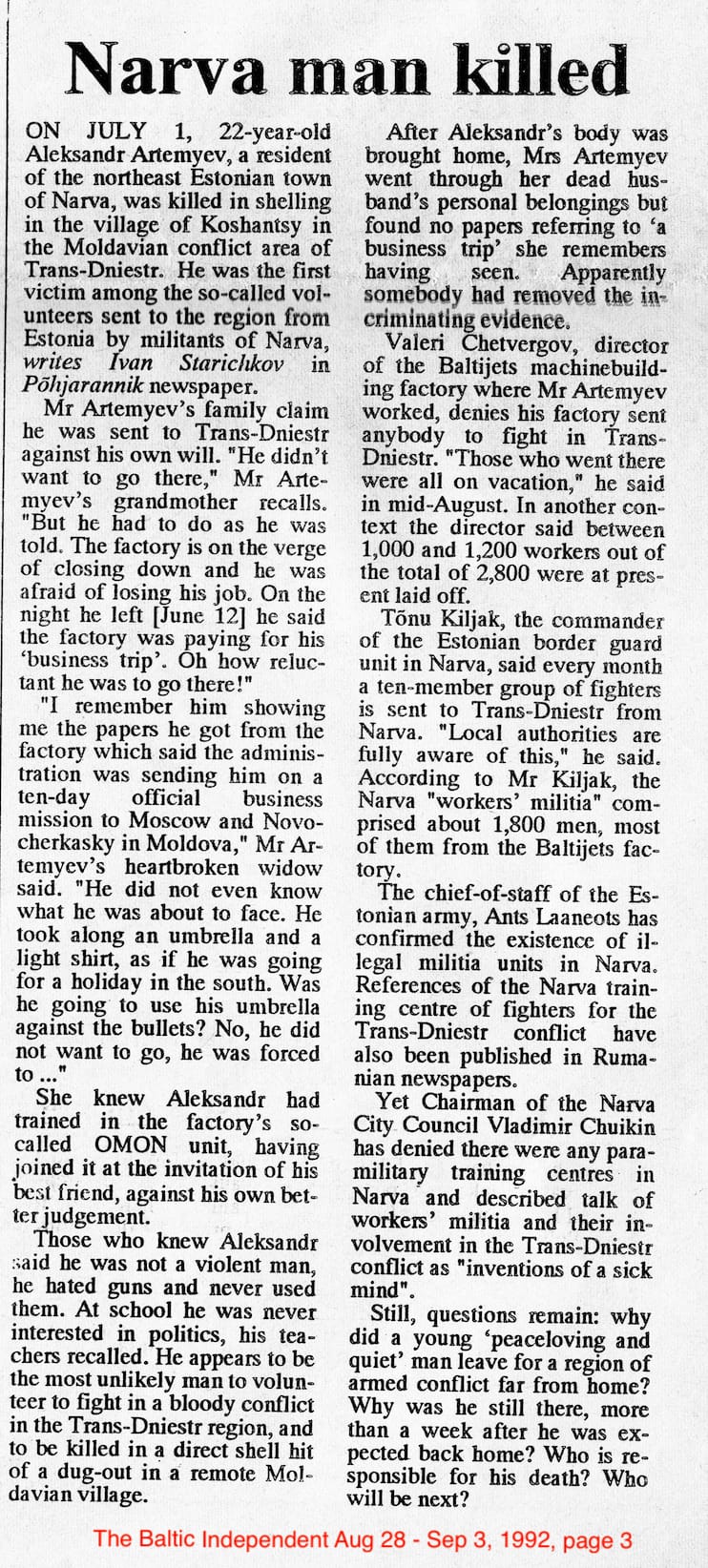
On the night of 12 June 1992, 22-year-old Narva resident Aleksandr Artemyev was told the Baltijets factory was sending him on a ten-day “official business mission” to Moscow and Novocherkassy. He packed an umbrella and light summer clothes, like a man heading on a holiday. Three weeks later, he was dead, killed by shelling in Trans-Dniestr, the first fatality among the so-called Narva “volunteers.”
His widow remembered him showing her those factory papers the night he left. After his death, she went looking for them among his belongings. They were gone. Somebody had already been through his things and removed the evidence.
The factory director, Valeri Chetvergov, denied sending anyone to fight. “Those who went there were all on vacation,” he said, apparently unaware that vacationers don’t usually require training in the factory’s in-house OMON unit first. Estonia’s own border guard commander in Narva confirmed a ten-man contingent shipped out to Trans-Dniestr every month, drawn mostly from Baltijets, out of a self-styled “workers’ militia” some 1,800 strong. Narva City Council chairman Vladimir Chiukin, dismissed the whole story as “inventions of a sick mind.”
1993: The Referendum Nobody’s Government Recognized
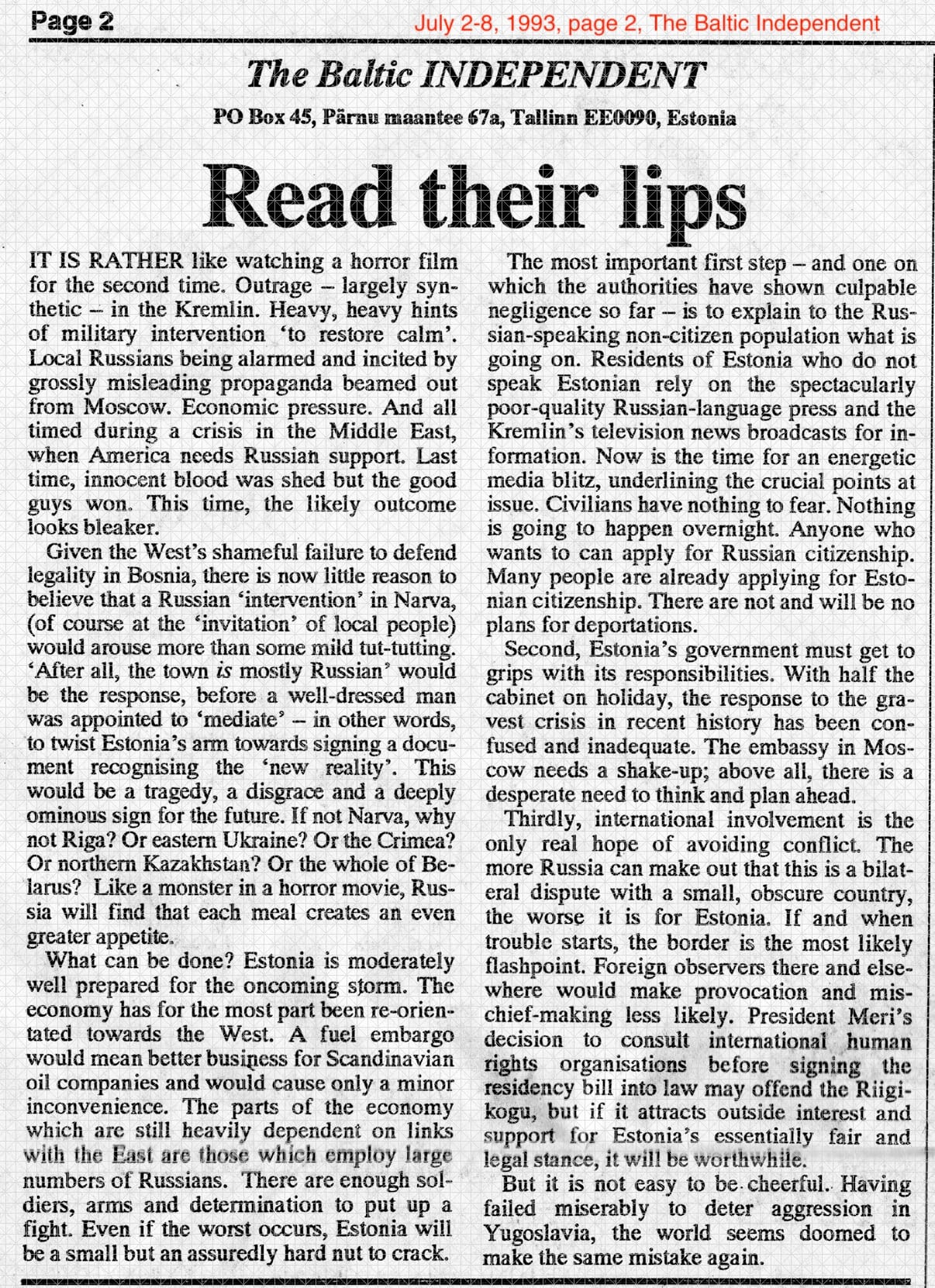
In June 1993, Yeltsin’s Foreign Minister, Andrei Kozyrev, upgraded Estonia’s new Aliens Act, a completely separate piece of legislation governing residence and work permits for non-citizens, to full “apartheid” and “ethnic cleansing” status, then threatened to cut off oil and gas deliveries if Tallinn didn’t reconsider.
"It must be understood that Russia cannot remain a disinterested observer if the Russian-speaking population should show a natural desire to defend itself against crude discrimination," Yeltsin stated in Moscow on 24 June 1993.
Estonia’s actual crime, as far as anyone could tell, was asking Soviet-era arrivals to apply for "residence and work permits," the same paperwork every country on Earth asks of immigrants, minus the part where Moscow gets to threaten your energy supply over it.
The Baltic Independent’s own editorial staff were reading the room three decades early.
On 16–17 July 1993, Narva and Sillamäe's councils decided to hold a referendum asking residents whether they’d like to become a “national-territorial autonomous region.”
The organizing itself gave the game away. On 9 July, 1993, “high-ranking Russian officials,” reportedly including one of Yeltsin’s own special envoys, met Narva council chairman Vladimir Chiukin not in Narva, but across the border in the Russian town of Kingissepp, to discuss the referendum Chiukin was, officially, organizing entirely on his own. Some of the ballot papers, per the Estonian government’s own press service, appeared to have been printed in Russia. Igor Mikheyev, the Russian consular representative in Narva, cheerfully endorsed the vote as “a positive development,” then denied, in the same breath, that the idea had come from Russia.
Advance voting opened five days early with no voting booths, and officials were reported to be telling people how to vote as they handed them their ballots; 220 people had already voted before polls officially opened. When the count came in, turnout was 54% in Narva and 60% in Sillamäe, with 97% and 98.6% respectively voting yes, a landslide that, according to referendum commission member Nikolai Kulikov (a councilman himself), was produced by a process “so haphazard the vote could not truly be called a referendum.” Kulikov’s own account included a group bussed in from St. Petersburg who cast ballots after the polling station had already closed, and security so lax the ballot boxes could easily have been tampered with before the count. The Baltic Independent’s own reporters watched stations hand out ballots without checking documentation, sometimes several at a time on request, inspiring the single best photo caption in the whole saga: “So This Is Democracy: People line up in Narva polling stations to get a ballot or three.”
Estonia’s Legal Chancellor had already ruled the entire exercise unconstitutional and void before a single vote was cast, which didn’t stop it from happening anyway. And when The Baltic Independent ran its own straw poll of Narva and Sillamäe voters afterward, most had no real idea what they’d been voting for, they wanted “a better life,” job security, a better home, and several believed the whole thing was about the economy rather than secession. Nobody running the vote seemed in any hurry to correct that impression.

The autonomy push folded within weeks. Estonia’s own retrospective take on why is refreshingly unsentimental: Trans-Dniestr worked because Russian troops backed it up. In Narva in 1993, Moscow was busy with its own political crisis at home, and there were no soldiers standing behind the ballot box.
1993: Gas dependency is a weapon (three decades before the rest of Europe realises)
While Narva argued about ballots, the Kremlin was demonstrating what leverage looks like. On 25 June 1993, the same week Estonia’s parliament passed the Aliens Act, Gazprom shut off gas to Estonia entirely, citing an unpaid $6 million bill that had, by complete coincidence, been sitting there peacefully until the vote passed. Latvia received the same treatment a day later over a separate debt. Lithuania got cut off on 27 June, officially over its own $43 million arrears, conveniently the same week Estonia’s aliens law was making headlines and the Kremlin’s foreign minister was on television calling it “apartheid.”
Three Baltic states, three gas cutoffs, one week. If you’re looking for the moment “energy as a weapon” became standard Kremlin doctrine rather than an unfortunate accounting coincidence, June 1993 is a very good place to start, thirty years before the rest of Europe learned the hard way.
While Moscow cut gas and threatened sanctions, Western diplomats sprang into action with the international community’s finest weapon: a strongly worded statement urging both sides to remain calm. Sweden’s Prime Minister Carl Bildt at least had teeth in his; he called out Russia’s “vicious circle,” diagnosing that Moscow’s own threats to “unilaterally implement imperialist politics” were exactly what kept the rest of Europe from taking it seriously as a partner.
2026: Narva is next
Narva’s story did not end with its destruction, nor with any desire to continue indulging imperial games, which now take place in the background as social media disinformation campaigns.
Meanwhile, the city is now writing another chapter, with investment flowing into new schools, public spaces and infrastructure, while the extraordinary remains of Kreenholm are finding a new life as a cultural space. The former textile empire has hosted concerts, exhibitions and international artists, and the annual Station Narva festival has helped turn the border city itself into a destination.
For centuries, imperial powers have tried to decide what comes next for Narva. These days, the Estonian city has its own answer for itself: Narva is next.
After the annexation of Crimea prompted endless speculation about whether “Narva is next”, the city appropriated the phrase for its own European Capital of Culture campaign: “Narva is next!” Not the next city to be re-absorded into empire, but a next destination for culture, music, innovation, and more.
This article is part of Amara's digitization project of her own articles from 1991 to 1995 from The Baltic Independent weekly newspaper. It is lighted edited with Bad Baltic to include context on interwar Narva. You can learn more and support Amara at Buy Me A Coffee.


