
Acclaimed Russia expert’s speaking tour in Russia hampered by lack of basic knowledge about Russia
John Mearsheimer is regularly introduced in the media as an expert on Russia, yet he was flummoxed about how to buy a coffee in Moscow. With Mearshei-mania not quite gripping Russia during his visit, we take a deep dive into how ‘realists’ lost touch with reality.
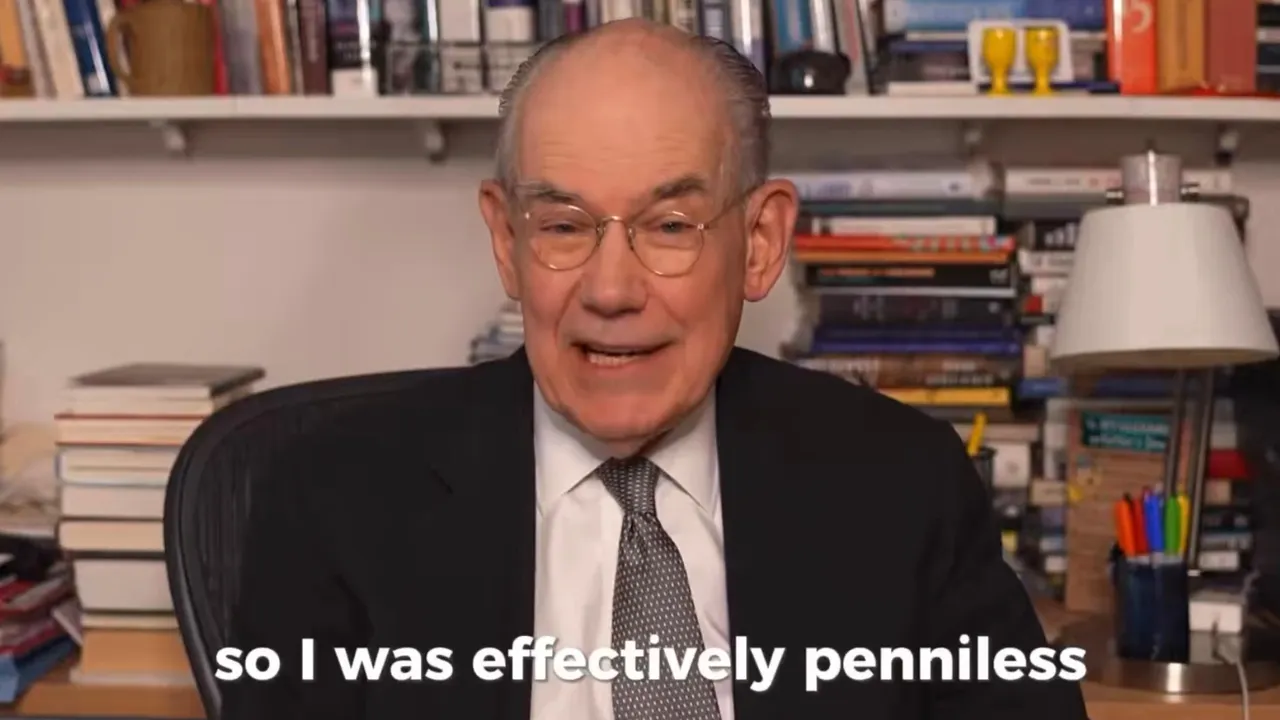
John Mearsheimer has been hailed as an intellectual titan by both ends of the political spectrum.
The University of Chicago professor is described by Tucker Carlson as “an oracle” who is “universally respected”, adding in a recent introduction that “he’s smart and he’s erudite, but above all, he is wise.” Left wing commentators, such as Hasan Piker and Noam Chomsky, have been just as fawning of what they describe as his courageous scholarly analysis.
This year alone, Mearsheimer has made more than 20 prominent media appearances, from Al Jazeera to Piers Morgan Uncensored, all of which emphasise that he’s a leading authority on understanding Russia.
And yet this same genius travelled to Moscow this month with American credit cards as his only means of payment, seemingly unaware of Russia’s financial sanctions.
“If you go into Russia, you cannot use your own credit card, or an American credit card, and you can’t use American money,” he revealed last week on his YouTube channel after returning.
“I did not go into Russia realising that. So I was effectively penniless when I was in Russia. If I went to a store or I went to a coffee shop, I had to make sure that I went with someone who could pay for me because I had no ability to pay. I couldn’t use any of my credit cards. I couldn’t use American dollars. You could only use Russian credit cards or rubles and I didn’t have any of them.”
His website features him dressed as Machiavelli, but he was flummoxed why his Visa didn’t work in Moscow. https://t.co/KBraYk1JZE
— Michael Weiss (@michaeldweiss) September 19, 2026
As Mearsheimer appears to have missed, Russia launched a full scale invasion of Ukraine more than four years ago, after which it was subject to sweeping Western financial sanctions. Russian banks were cut off from SWIFT, while Visa and Mastercard suspended their Russian operations.
It was all quite widely reported at the time.
He kept thinking his card would inevitably win because it was the stronger card.
— BrenFella🇺🇦🇳🇿🇺🇦 🍖³📈 (@FellaMortz42) September 20, 2026
Mearsheimer continued with his profound analysis about his discovery.
“Correspondingly, the Russians cannot use American credit cards,” he explained. “So if you’re a Russian and want to subscribe to the New York Times, you can’t use an American credit card to subscribe because American credit cards can’t be used in Russia. So you would have to use your Russian credit card. But the problem is you can’t use a Russian credit card in the West. So any Russian that wants to subscribe to the New York Times or the Wall Street Journal or some Substack site cannot do it through normal channels.”
It is wild to bring up the topic of access to media in Russia while omitting the rather crucial additional context that Russia severely restricts international news anyway. All are blocked or throttled, requiring the use of a VPN instead, but using that is legally very risky, especially so if you are creating a payment trail.
But this repression only affects ordinary people. It is not the concern of important visiting academics Like Mearsheimer.
The news of his trip to Russia earlier this month was first broken a few weeks ago by Brian McDonald, the former Russian state propagandist at RT, who seemed to be expecting some kind of Mearshei-mania to grip Moscow akin to the Beatles arriving in America.
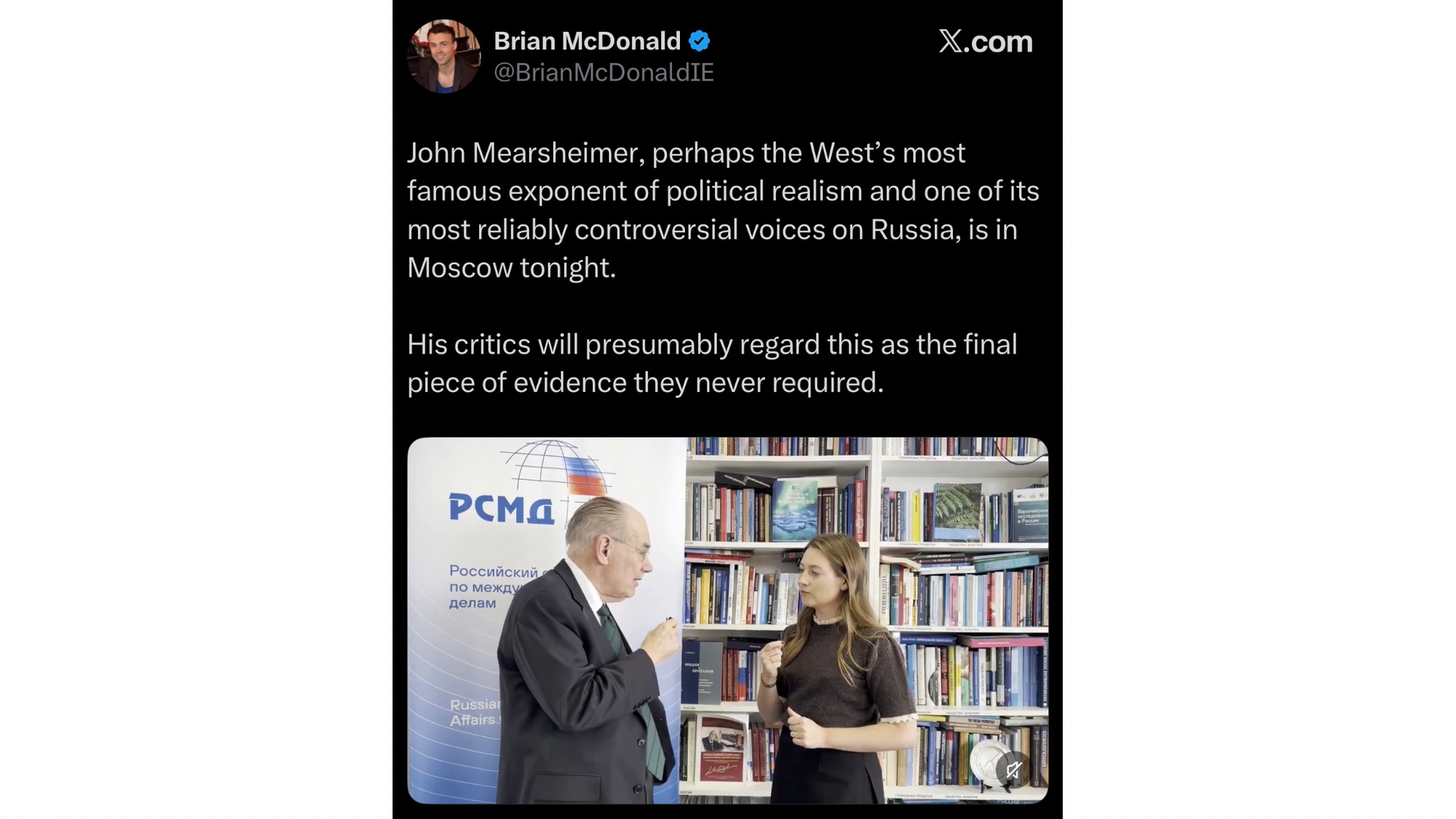
In reality, almost no one cared during his visit. Mearsheimer’s sympathy for Russia is not news to critics [Surely ‘realists’? - Editor].
The visit also failed to garner much interest inside Russia. Audiences there cheering on the war are more accustomed to jingoistic domestic propaganda, not the feeble excuses of academics like Mearsheimer who seem unaware that their own style of “realist” pro-Russia talking points are only designed for Western audiences.
Realism unpacked
Mearsheimer is widely considered the leading proponent of political realism.
It’s a theory of international relations used to explain (and often justify) the idea that “might makes right”, hence it provides academic-sounding excuses for Russian imperial expansionism. That’s why supporters of Russia’s war seek to elevate people like Mearsheimer in the West as Russia experts even if they are flummoxed by how to buy a coffee in Moscow.
Machiavelli is considered a key founding father of the realist tradition, which is why Mearsheimer poses as his intellectual heir.
Machiavelli was the first to explicitly detach realist thinking from any sense of morality. His seminal work, The Prince, emphasises that rulers maintain the power and security of their state not just through force, but also through cruelty, deception, broken promises, and manipulation, but such behaviour cannot be judged by ordinary morality as states will secure their interests how they must.
Realists content that we must accept this reality to understand how “great powers” rationally behave and therefore how the world works, and how we can all live within it.
Mearsheimer’s own brand of this dogma is ‘offensive realism’, putting extra emphasis on the idea that great powers need to keep expanding their power to dominate their region for their own security.
Not quite an Oracle
With this analytical approach, fans of Mearsheimer claim he accurately predicted the Russia-Ukraine war.
That’s somewhat fair based on what he said in 1993. Mearsheimer argued then that Ukraine needed to retain its nuclear deterrent in order to avoid a Russian attempt at reconquest with all its devastating consequences.
But his fans don’t like to talk about that one time he was actually right.
They point instead to his ‘prediction’ in 2014 when he again said Ukraine would be devastated but that it would be the fault of the West for encouraging Ukraine to leave Russia’s sphere of influence, not the fault of those re-conquering invaders actually doing the devastating.
This incredible ‘prediction’ was made in September 2014, by the way, which is nearly half a year after Russia invaded Ukraine with Crimea occupied by Russia and fighting by Russia already underway in Eastern Ukraine too.
It’s the geopolitical equivalent of watching arsonists set fire to a building and then, as the flames begin billowing through it, you boldly predict that the house is going to burn down.
But Mearsheimer then insisted Russia wouldn’t launch a full scale invasion of Ukraine, just before Russia.. er, launched a full scale invasion of Ukraine. Since then, he’s pivoted to constantly predicting Ukraine’s imminent capitulation.
This then is like watching firefighters manage to save a large portion of that burning building, along with many lives of those inside, but you keep standing around constantly repeating that the fire can’t be stopped and the firefighters should give up.
Here’s Mearsheimer being wrong about Ukraine again, and again, and again, and again, and again.
If we're living in a simulation then Mearsheimer is clearly a non-player character -- no development despite being proven wrong over and over again.
— Martin 🇪🇪 (@martintynvf) September 9, 2026
And here’s what’s really odd about that.
If you genuinely believed in realism as an analytical approach, you should have very easily foreseen Russia’s full scale invasion of Ukraine in 2022, like many of us in the Baltics did, especially when there was a giant invasion force literally visible from space.
Denying that imminent invasion didn’t fit with realism. It fit with Russian propaganda at the time.
A guy who cosplays as Machiavelli is supposed to be an expert on explaining that exact kind of deception, not joining in with it. But realists like Mearsheimer have abandoned their theory as a way to describe the world and are instead propping up the narratives of certainly larger states while offering policy prescriptions for certain smaller states, none of which reflects their experience securing themselves against that aggression.
Even Hasan Piker now says Mearsheimer is too sympathetic to Russia and too overconfident about “Russia’s current situation”.
Hasan Piker has broken ranks with John Mearsheimer following his visit to Russia, saying that the realist scholar is too sympathetic to Russia and too overconfident about its situation.
— Bad Baltic (@BadBalticTakes) September 22, 2026
Unrealistic, you might say.
Note that Hasan incorrectly uses the past-future tense when… pic.twitter.com/nLZazuMiHG
All this would suggest that a lot of realists, including its leading proponent, are not genuinely trying to understand and predict this might-makes-right world. They are cheering on a specific version of it.
Take a look at how Mearsheimer and many of his fellow travellers contradict themselves elsewhere. On the US-Iran war, for example, Mearsheimer is clearly rooting for Iran against what he describes as aggression, not lecturing Iranian leaders and their backers about the devastation they have brought upon their country by provoking a great power.
If the argument is that the US should stick to being a regional hedgemon then that doesn’t add up either based on how Mearsheimer has sharply criticised US interventionism in the Americas, such as against Venezuela. Similarly with Israel and Palestine, realists like Mearsheimer completely abandon any sympathy for the regional hedgemon and its arguments about security.
Mersheimer counters that, in these examples, the smaller nations posed no real security threat to the great power and so its behaviour was counterproductive.
And this gets to the heart of why the application of realism is such junk political science, not just because so many realists like to see the world only through the lens of certain larger states, but also because it’s terrible policy advice with no basis in history and reality, which they suddenly understand when analysing a larger state they don’t like, such as the US or Israel.
Russia was very obviously more secure before it launched its full scale invasion of Ukraine. It was more secure than that before it launched its initial invasion in 2014. Ukraine was a good neighbour, which posed no threat, and was even committed to neutrality. As a result of its realist-style actions, Russia has lost 1.5 million causalities and now endures nightly air raids from that neighbour as the world’s most battle-hardened nation still rapidly developing its capabilities to make the great power pay for its crimes.
Going back further, the Nazi-Soviet Pact is perhaps the clearest example of textbook realist theory in practice, but it also proved to be the worst idea in human history, devastating even to the two powers that came up with it, eventually leading to the destruction of both of them.
The world’s most secure countries don’t actually behave at all like realist scholars like to imagine. All of them are democracies with strong civic societies, respect for rules and freedoms, and good neighbourly relations. They also happen to be the most prosperous countries with the highest standards of living, which could more genuinely be referred to as a nation’s interests.
Meanwhile, the countries that behave as realist scholars suggest with underhand force projection, like Russia and Iran, actually have dreadful security and dreadful quality of life by any remotely objective or honest assessment.
The main point of Mearsheimer’s YouTube video was that Moscow does not feel like a city at war. Life continues perfectly normally in many ways across Russia, he claimed (shortly before Ukraine launched its largest night of drone strikes on Moscow yet, hitting the city’s oil refineries and disrupting flights).
This has long been a common trope among Westerners invited to visit foreign autocratic regimes and then reporting back on the relative normality of every day life, but based on a standard that they would never tolerate as good enough for their own country. It’s also a long way from the goals of Russia’s three day war, which were not to preserve some aspects of normal life a few thousand days later.
Baltic realism
Despite their antipathy toward us, people in the Baltics who have consistently predicted Russia’s aggression correctly would actually agree with realists on many of their tenets. The main difference is that we recognise the world is complex, everyone has agency, leaders are not purely rational, big states don’t always know (or care) what’s in the best interests of their nation, and we are not fatalist about a might-makes-right world.
Ukraine will outlive Mearsheimer. It will survive and thrive as a proudly sovereign state that belongs to nobody’s sphere of influence.
We know that partly because we have a better understanding of agency, and also because we understand that rejecting might-makes-right is not actually just wishy-washy idealism.
Those countries that are most secure, most prosperous, and most happy also tend to be the most supportive of a rules-based world of sovereign nations. That’s not just out of some naive idealism. It’s pure self-interest too. As we have seen time and again through history, every country is better off when smaller countries exist securely too.
Call that Baltic realism.


